Couch to 5km Run: Why Your First Weeks Are the Hardest
"Thinking about starting a couch to 5km run but worried you'll end up injured like last time? One thing to understand is that you're running on two clocks. Your heart and lungs get fit in weeks, but your joints and tendons take months to catch up, and that gap is where most beginners get hurt. This guide breaks down the science of those first few weeks: why run-walk intervals work, how to avoid shin splints, and exactly what to do from week one to eight."

Three weeks in, something strange happens. Your breathing gets easier. The runs that left you gasping now feel almost manageable. You think: I've got this. So you push a little further, run a little faster, skip the walk breaks because you don't seem to need them anymore.
That's usually the exact moment your body starts to break.
Here's the thing to remember when you start a couch to 5km run: you're not running on one clock. You're running on two. And the reason most beginners end up icing their shins on the couch by week four isn't a lack of fitness or willpower - it's that they trust the fast clock and ignore the slow one. Get that relationship right and you'll run your first 5km. Get it wrong and you'll join the millions whose running shoes are gathering dust in a cupboard right now.
This is how the two clocks work, and how to run in a way that respects both.
The Two Clocks Running Inside You
Your cardiovascular system is the fast clock. Heart, lungs, blood vessels. Give it a few weeks of running and it upgrades fast — more capillaries feeding your muscles, better oxygen delivery, a bigger stroke volume with every heartbeat. This is why running feels dramatically easier by week three. Your engine has genuinely improved.
Your musculoskeletal system is the slow clock. Bones, tendons, ligaments, cartilage. These tissues have far less blood supply and much lower metabolic activity than your heart and lungs, so they remodel on a completely different timeline. The collagen in your tendons and the mineral density in your bones need months of repeated loading to actually get stronger — not weeks.
That mismatch is the whole problem. Your fitness outpaces your structure. Research on new runners identifies a high-risk injury window that peaks somewhere between three and eight months in — precisely when people feel fit enough to push, and precisely when their tissues haven't caught up. You feel ready. Your Achilles disagrees. The Achilles is right.
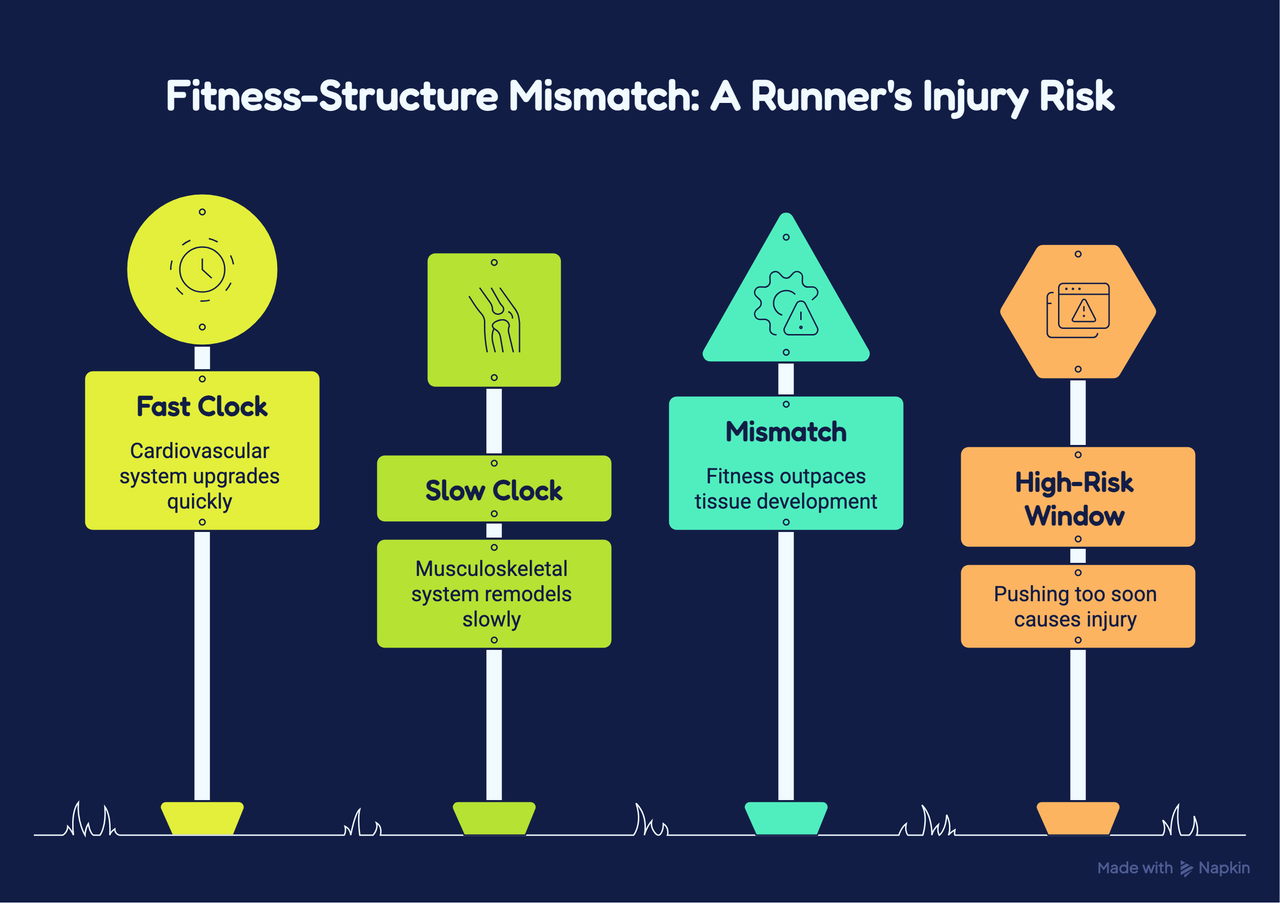
Every fix in the rest of this article is really the same fix: slow down to the pace of the slow clock, even when the fast clock is showing off.
Why Run-Walk Isn't a Beginner's Crutch The first place people ignore the slow clock is here. Run-walk intervals feel like training wheels - something to graduate out of as fast as possible. That instinct is exactly backwards.
The numbers explain why. Running sends roughly two and a half to three times your bodyweight through your legs with every stride. Walking brings that down to around one times bodyweight. Those walking intervals aren't a rest for your lungs — they're a pressure valve for your joints and tendons, dropping the impact load right down while your cardiovascular system keeps adapting.
That's the elegance of a proper couch to 5km plan. The intervals let your fast clock keep improving while giving your slow clock the recovery windows it needs to catch up. Every good couch to 5km running plan is built on this — not because beginners are fragile, but because tendons are slow. Rush the intervals and you've thrown away the one tool that keeps the two clocks in sync.
The Single-Leg Truth About Your Knees
Here's what running actually is, mechanically: a series of single-leg hops. At no point are both feet on the ground. Every stride, one leg absorbs your entire bodyweight and controls your pelvis on its own.
This is where the slow clock hides a second trap. If the muscles that stabilise that single-leg landing — your glutes, particularly the glute medius on the side of your hip — aren't strong enough yet, your pelvis drops on the unsupported side and your knee caves inward. That collapse is the mechanical origin of a huge share of beginner knee and hip pain. It's not the running that hurts you. It's the running without the stability to control it.
The evidence here is hard to argue with: runners who build hip and core strength into their routine experience somewhere in the region of 40–50% fewer overuse injuries than those who just run. That's not a rounding error. That's the difference between finishing your programme and losing week five to a sore knee.
If you're carrying an old knee, hip, or back issue and you're genuinely not sure it'll hold up, don't guess your way into it. A movement assessment tells you exactly what you're working with and how to build around it — far cheaper than an injury that costs you two months.
The Form Fix That Saves Your Shins
Shin splints have a name most people don't know — medial tibial stress syndrome — and a cause most people don't suspect. It's not mileage. It's how your foot meets the ground.
The culprit is overstriding: landing with your foot too far out in front of your body. When you do that, your shin hits the ground at an angle that creates a braking force — your own momentum working against you — and that force travels straight up into the shin bone with nothing to absorb it. Do it a few thousand times and the tissue gives.
The fix costs nothing and takes one run to learn. Speed up your cadence to somewhere around 160 to 180 steps per minute. Quicker, shorter steps force your foot to land underneath your hips instead of reaching out in front. The cue that makes it click: think of each step as a light, quiet tap, not a long reaching stride. If you can hear yourself thudding, you're overstriding. Add a slight forward lean from the ankles — not bent at the waist — and you've corrected the two errors behind most beginner shin and knee pain in a single adjustment.
Stretch After, Not Before
One more place the fast-clock instinct betrays you. It feels responsible to stretch before a run — long, held stretches, calf against the curb, the way you were taught in school.
It works against you. Static stretching before running measurably reduces your muscles' force output for up to an hour afterward. You're switching the muscle off at the exact moment you need it firing. Save the long holds for after the run, when they genuinely help restore muscle length and reduce stiffness. Before you run, move instead — leg swings, walking lunges, a few bodyweight squats. That raises tissue temperature and wakes the nervous system up rather than sedating it.
The Habit Runs on a Slow Clock Too
Even your motivation obeys the two-clock rule. People assume the hard part of a couch to 5km is physical. It's usually not. It's the day you don't feel like it — and what you do next.
The research is oddly specific here. Missing one session has almost no effect on a forming habit. Missing two in a row is where it quietly collapses, because that's the point your brain reclassifies the whole thing as optional. So the rule that actually keeps people running isn't "push hard." It's "never miss twice." And it comes with permission most beginners never give themselves: a ten-minute session counts as much as a forty-minute one for holding the habit together. In the early weeks, showing up is the entire skill. Distance is a problem for later.
This is exactly where a structure built around your real life — not a generic app schedule designed for a 22-year-old — earns its keep. That's what online coaching is built to do, and for anyone Christchurch-based who'd rather have eyes on their form from day one, 1:1 personal training delivers the same principles in person.
What To Actually Do This Week
Three runs, on non-consecutive days. Not four — the rest days are where the slow clock catches up, so skipping them defeats the entire point.
Each session: five-minute walk to warm up, then alternate 60 seconds of running with 90 seconds of walking for 20 minutes, then a five-minute walk to cool down. Keep the running conversational — if you can't talk in full sentences, you're pushing the fast clock too hard for week one.
Focus on quick, light steps landing under your hips, not long strides. Do your static stretches after, never before. And don't run two days in a row, however good you feel - that feeling is the fast clock talking.
Write down what you did each time, even just a note on your phone. In a month you'll want to see the pattern, not trust your memory. And if you miss a run? Do the next one. Never chase the missed session with a double - that's the fast-clock instinct that gets people hurt.
Ready For The Full Plan?
Knowing the principles gets you off the couch safely. But a blog can't watch your progress and tell you exactly when to push and when to hold. The WRK Couch to 5km Running Plan does: an 8-week, session-by-session plan delivered through our WRK Training App, with home-based strength work to protect your knees, stretching guidance, and nutrition support built in — all for $27. Both clocks, handled for you. Start the Couch to 5km Running Plan
Common Inquiries on this Topic
How long does a couch to 5km run plan take?
Most plans run 8 to 9 weeks, training three times a week. But that timeline isn't a contract. Some people need 10 or 12 weeks, and that's completely fine - the slow clock doesn't care about your schedule. If a week feels too hard, repeat it and move on. You're not trying to beat the plan. You're trying to build something your body can keep doing.
How long does it take to run 5km as a beginner?
For most new runners, covering 5km takes somewhere around 30 to 40 minutes. Speed isn't the goal when you're starting - finishing the distance is. A 5km with a couple of walk breaks still counts as a 5km.
Can I do couch to 5km on a treadmill?
Yes. The run-walk intervals work identically indoors or out. A treadmill actually makes it easier to hold a steady, conversational pace, and the slightly softer surface is a little kinder on your joints than concrete.
How do I stop getting shin splints when I start running?
Two things fix most beginner shin pain. First, quicken your cadence - aim for short, light steps landing under your hips rather than long strides reaching out in front of you. Second, don't rush the walk intervals or skip your rest days. Shin splints are almost always your fast clock dragging your slow clock somewhere it isn't ready to go.
Do I need to run every day?
No - and you shouldn't. Three runs a week on non-consecutive days is plenty for a beginner. The rest days aren't time off; they're when your body actually adapts and gets stronger. Running every day is one of the fastest ways to get injured.
What if I miss a week?
Pick up where you left off. Don't try to "catch up" by doubling your next session - that's exactly the kind of jump that causes injuries. Missing one session is nothing. The only rule that matters: try not to miss two in a row.
Do I need to be fit to start?
No. If you can walk for 30 minutes, you can start a couch to 5km run. The whole point of the run-walk structure is that it meets you where you are - you don't fake fitness on day one, you build it week by week.
References & Clinical Sources
The guidance in this article is grounded in research across running physiology, biomechanics, and behaviour change:
Relph, N., et al. (2023). Research into Couch to 5K completion and dropout, linking early attrition to musculoskeletal injury and aggressive week-to-week progression. McConnochie, G., et al. (2026). Royal Society Open Science — findings that weak back and core musculature, rather than leg fatigue, drive reductions in running economy in fatigued runners. Bezerra, A., et al. (2025). Journal of Biomechanics — research showing lumbopelvic (torso and pelvic) motion is a primary contributor to lower-leg acceleration and deceleration during running. Core Training and Running Economy (2019). An eight-week core training study demonstrating improved core endurance, balance, and running economy through reduced oxygen consumption at higher exertion. Lally, P., et al. (2010). European Journal of Social Psychology (University College London), "How are habits formed: Modelling habit formation in the real world" — the basis for the two-day rule, showing that missing a single day does not derail a forming habit, but missing two consecutive days can. Maltagliati, S., et al. (2024). Health Psychology Review — systematic review and meta-analysis finding habit formation takes a median of roughly 59–66 days, not the commonly cited 21. Clear, J. (2018). Atomic Habits — the framework of identity-based habits: becoming "the type of person who runs" rather than fixating on a distance goal. Fogg, B.J. (2020). Tiny Habits — on the unreliability of motivation and the case for building behaviour through system design and environmental cues rather than willpower.
This article is educational and general in nature. If you have an existing injury or health condition, check with your GP or a qualified health professional before starting a new running programme.
H. Richards
Personal TrainerWith over 20 years of experience coaching high performers, H. Richards delivers precision training frameworks built on evidence and practical application. His approach cuts through the noise to help you achieve sustainable results, backed by consistently excellent 5-star client reviews.
Explore Coaching ProgramsStart the Couch to 5km Running Plan
Take our 2-minute assessment to evaluate your current protein intake and training consistency.
Take the Free AssessmentRelated Guides & Protocols
 General
Finding a Personal Trainer in Christchurch: What to Look For
Choosing a personal trainer is about more than price or location. Here’s how to find a personal trainer in Christchurch who matches your goals, experience level, and lifestyle.
 General
Low Energy After Work? Here’s What to Look at First
If you keep wondering why you’re tired all the time after work, the issue is usually not willpower. It is often a mix of sleep, stress, food, recovery, and training load that has quietly tipped out of balance.