Low Energy After Work? Here’s What to Look at First
"If you keep wondering why you’re tired all the time after work, the issue is usually not willpower. It is often a mix of sleep, stress, food, recovery, and training load that has quietly tipped out of balance."

Low Energy After Work? Here’s What to Look at First
If you feel flat, foggy, or wiped out by the end of the workday, you are not alone. A lot of adults assume they just need to be tougher, more disciplined, or more motivated. Usually that is not the real issue.
Low energy after work is often a systems problem, not a character flaw. When sleep is a bit short, stress is running high, meals are inconsistent, and training or life load keeps building, energy tends to fall off. The good news is that this is usually something you can improve once you identify the bottleneck.
Quick Answer
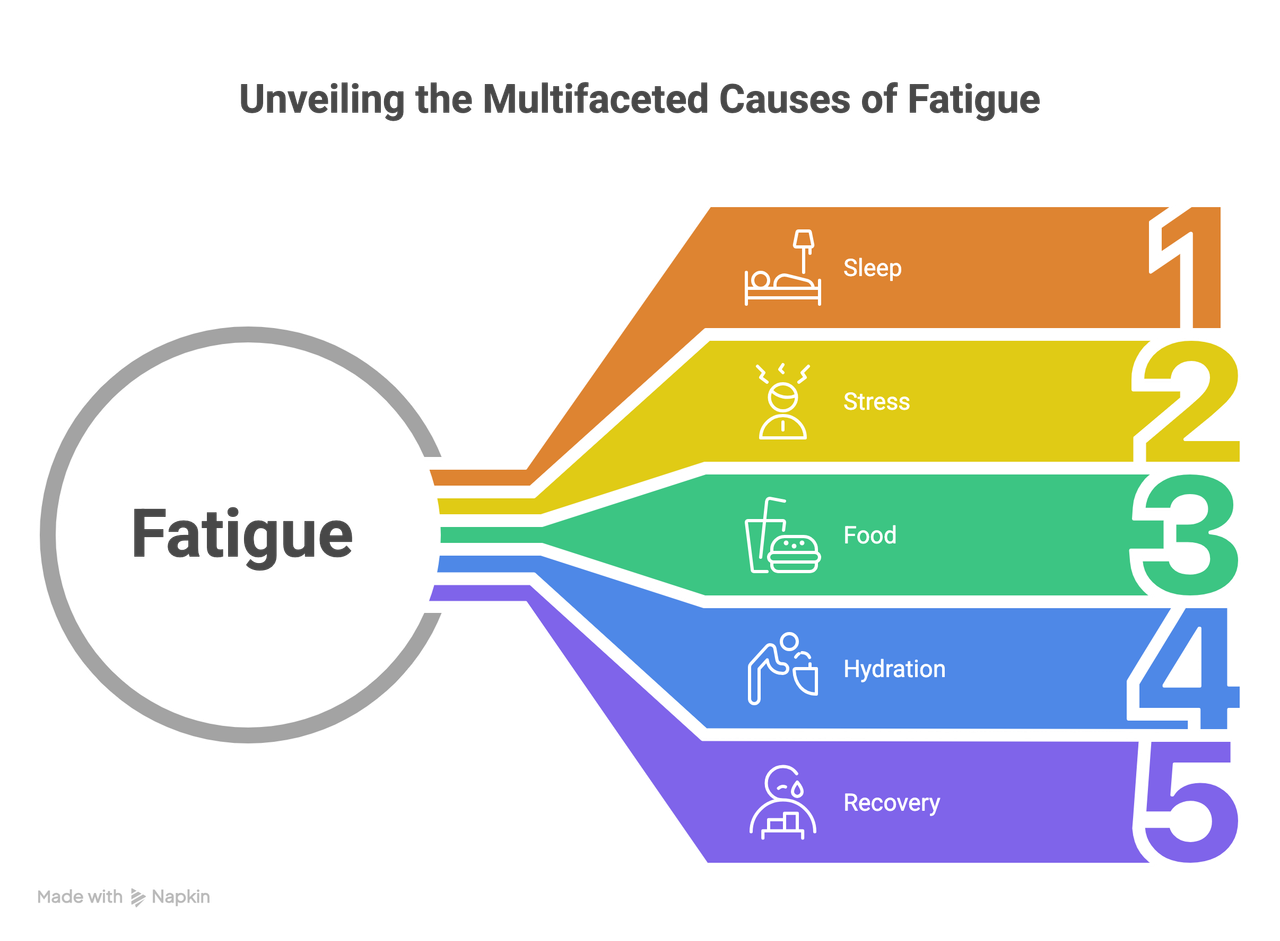
If you keep asking, “Why am I tired all the time after work?” start by looking at five things first: sleep, stress, food, hydration, and recovery from training and life.
For most people, low energy after work is not caused by one dramatic problem. It is usually the result of several small drains stacking up across the day. The fix is often less about trying harder and more about tightening up the basics that support energy in the first place.
1. Start with sleep before you blame anything else
Sleep is the first place to look because it affects almost everything else. If sleep is poor, you are more likely to feel mentally flat, physically heavy, less patient, and less motivated by late afternoon. Adults generally need at least 7 hours of sleep on a regular basis, and many do best in the 7 to 9 hour range. Getting less than that consistently can affect mood, concentration, decision-making, and daytime energy.
This is where people get caught out. You may still be functioning well enough to get through work, but that does not mean you are well recovered. You are just getting by.
A few signs sleep may be the main bottleneck:
- You struggle to wake up without several alarms
- You rely heavily on caffeine to get going
- You feel a big crash in the afternoon
- You feel “tired but wired” at night
- You sleep in on weekends because you are trying to catch up
One important point here is that low energy does not always mean you need more motivation. Sometimes it means your body is asking for more recovery.
2. Check your stress load, not just your calendar
A full day of work is not only physically tiring. It is mentally expensive. Meetings, deadlines, constant notifications, commuting, parenting, and making decisions all add up. Even if you have sat at a desk most of the day, your nervous system may still feel cooked.
Chronic workplace stress is strongly linked to burnout, and the World Health Organization describes burnout as an occupational syndrome resulting from chronic workplace stress that has not been successfully managed. It includes exhaustion, more mental distance from work, and reduced professional efficacy.
That matters because many people misread stress-related fatigue. They think, “I should still have enough energy to train or cook or focus tonight.” But if your brain has been switched on for 9 or 10 hours straight, your low evening energy may be a stress signal as much as a fitness or nutrition issue.
A useful question is this:
By the time work ends, do you feel physically tired, mentally drained, emotionally snappy, or all three?
That answer tells you a lot.
If it is mostly mental and emotional fatigue, the first fix may not be pushing harder in the gym. It may be reducing decision load, setting firmer work boundaries, taking real breaks, or simplifying your evenings for a while.
3. Look at how you are eating during the workday
A lot of people with low energy after work are under-fuelled, over-caffeinated, or running on convenience food that does not hold them for long.
You do not need a perfect diet to feel better. But you do need meals that are stable enough to support your day.
Common patterns that can leave you feeling wrecked by 5 pm:
- Skipping breakfast and relying on coffee
- A light lunch with not much protein
- Long gaps between meals
- High-sugar snacks that give you a quick lift, then a crash
- Not eating enough overall, especially if you are dieting hard
Meal quality matters too. Meals with a decent source of protein, some fibre, and enough total food tend to support steadier energy better than random snacks or highly processed grab-and-go options. Research on meal timing and metabolic health also suggests earlier and more regular eating patterns may support better glycaemic control and insulin sensitivity for many adults.
In plain English: if your workday food is chaotic, your energy often will be too.
A simple place to start:
- Make sure lunch actually looks like a meal
- Include protein
- Include carbs you tolerate well
- Include fruit or veg
- Do not leave yourself running on fumes until dinner
4. Do not ignore hydration and the afternoon slump
Mild dehydration can make you feel more sluggish, less alert, and less switched on than usual. It does not have to be dramatic to matter. Even relatively small drops in hydration status have been linked with worse mood and poorer attention in research.
This becomes more obvious when paired with the normal afternoon dip in alertness. Human energy is not perfectly steady across the day. Many people naturally feel a slump in the early to mid-afternoon, which can feel even worse if lunch was poor, sleep was short, and water intake has been low.
That is why the late-workday crash is often a pile-up, not one single cause.
Easy wins here:
- Keep water visible while you work
- Start the day hydrated instead of trying to catch up later
- Get outside for a short walk if your energy drops
- Use movement to reset, not just more caffeine
5. Make sure your training is helping your energy, not draining it
Exercise can improve energy and reduce fatigue over time. Regular physical activity is associated with better energy, health, and wellbeing, and adults are generally advised to aim for at least 150 minutes of moderate activity per week plus strength work on 2 days.
But there is a catch.
If your life stress is already high, your sleep is poor, and your food is inconsistent, more training is not always better. Sometimes the issue is not that you are doing too little. It is that your current training load does not match your current recovery capacity.
A few clues this might be happening:
- You feel worse after training instead of better
- Your performance is dipping for weeks
- You are always sore
- Your resting motivation is low
- You are dragging yourself through every session
- You are trying to train hard while also dieting hard and sleeping badly
That does not mean training is the problem. It means the balance between stress and recovery may be off.
Often the best move is not to stop training. It is to adjust the dose:
- Pull back intensity for a week or two
- Keep sessions shorter
- Focus on strength basics
- Swap one hard session for walking or easy cardio
- Eat enough to recover
- Treat sleep as part of the plan
6. Know when low energy might need medical follow-up
Most cases of low energy after work are linked to lifestyle and recovery patterns. But not always.
Persistent fatigue can sometimes be related to things like iron deficiency anaemia, sleep apnoea, thyroid issues, diabetes, depression, medication side effects, or other health problems. The NHS notes that ongoing tiredness can have a range of causes, and sleep apnoea in particular can leave people feeling very tired and struggling to concentrate during the day.
It is worth getting checked if:
- Your fatigue has become constant
- You wake unrefreshed even after enough time in bed
- You snore heavily or wake gasping
- You feel unusually short of breath
- You are getting dizzy
- You have unexplained weight loss
- Your mood has changed significantly
- Your energy is getting worse despite improving the basics
That is not alarmist. It is just sensible.
7. What to do first this week
If your energy has been slipping, do not try to fix everything at once. Start with the biggest likely bottlenecks.
For the next 7 days, focus on:
- A more consistent sleep and wake time
- A real lunch with protein and enough food
- Water intake through the day
- A short walk outside in the afternoon
- Slightly easier training if you are run down
- A bit less evening screen time so sleep is easier
That may sound simple, but simple is often what works.
Final Thoughts
Low energy after work usually is not a sign that you are lazy or weak. More often, it is a sign that one or more parts of your system are under strain.
Sleep, stress, food, hydration, and training load all affect how you feel at the end of the day. When several of them drift at once, energy drops fast. When you improve the bottleneck, things often start to feel more manageable surprisingly quickly.
If you have been wondering why you are tired all the time after work, start with the basics before you assume something is wrong with your motivation.
Common Inquiries on this Topic
FAQ Section
Why am I tired all the time after work even if I sit at a desk?
Because mental load still creates fatigue. Long periods of concentration, constant decision-making, stress, poor breaks, poor sleep, and inconsistent food intake can leave you exhausted even without physical labour.
Can exercise help with low energy after work?
Yes, in many cases. Regular exercise can support better energy and wellbeing. But if your sleep, food, and recovery are poor, training too hard can make you feel worse instead of better. The right amount matters.
What should I eat to avoid low energy after work?
Aim for regular meals that include protein, fibre, and enough total food. A decent lunch often helps more than people expect. Skipping meals, living on coffee, or relying on sugary snacks can make the late-day crash worse.
Is caffeine the answer if I feel flat every afternoon?
Not usually. Caffeine can be useful, but it does not solve poor sleep, under-fuelling, dehydration, or chronic stress. If you need more and more of it to feel normal, that is usually a sign to look upstream.
When should I see a doctor about fatigue?
If fatigue is persistent, worsening, affecting daily life, or showing up alongside symptoms like heavy snoring, breathlessness, dizziness, low mood, or unexplained weight loss, get it checked.
References & Clinical Sources
References
- American Academy of Sleep Medicine and Sleep Research Society. Recommended Amount of Sleep for a Healthy Adult.
- CDC. Shiftwork, Long Work Hours, Fatigue.
- World Health Organization. Burn-out an occupational phenomenon.
- Wender CLA, et al. The Effect of Chronic Exercise on Energy and Fatigue States.
- WHO. Physical activity guidance for adults.
- Zhang N, et al. Effects of Dehydration and Rehydration on Cognitive Performance and Mood.
- NHS. Tiredness and fatigue.
- NHS. Sleep apnoea.

H. Richards
Personal TrainerWith over 20 years of experience coaching high performers, H. Richards delivers precision training frameworks built on evidence and practical application. His approach cuts through the noise to help you achieve sustainable results, backed by consistently excellent 5-star client reviews.
Explore Coaching ProgramsIf your energy has been slipping and you are not sure what is driving it, coaching can help you figure out the real bottleneck and build a plan that actually fits your life.
Take our 2-minute assessment to evaluate your current protein intake and training consistency.
Take the Free Assessment