Can You Still Lose Weight and Drink Alcohol on GLP-1's??
"Can you still lose weight while drinking alcohol on a GLP-1? Yes - but alcohol can make the process harder. Learn how drinking affects calories, appetite, sleep, hydration, recovery and muscle preservation on Ozempic, Wegovy and Mounjaro."
Protecting Lean Mass on GLP-1 Medications?
Avoid the metabolic slowdown caused by rapid muscle loss. Pair your medication with our coach-designed resistance protocols.
Read the Lifting Protocol → Explore Coaching Tools →Can You Still Lose Weight and Drink Alcohol on GLP-1s?
Yes. You can still lose weight while drinking alcohol on a GLP-1. Alcohol does not make fat loss impossible, but it can make your calorie deficit harder to maintain and may affect appetite, food choices, sleep, hydration and training recovery. For people using medications such as Ozempic, Wegovy or Mounjaro, there is also another consideration: reduced appetite can make it harder to get enough protein and nutritious food, so how you use your calories matters.
Medical disclaimer: This article is for general educational purposes and is not medical advice. GLP-1 medications are prescription medicines, and individual advice can vary depending on your medication, dose, health conditions and other medicines. If you are unsure whether alcohol is appropriate for you, speak with your prescribing healthcare professional.
Can You Drink Alcohol and Still Lose Weight on a GLP-1?
Yes.
You do not have to give up alcohol completely to lose weight.
But that doesn't mean alcohol is irrelevant.
When you're using a GLP-1, your appetite may already be significantly reduced. That can make it easier to eat fewer calories, but it can also make it harder to consistently get enough protein, fluids and nutrient-dense food.
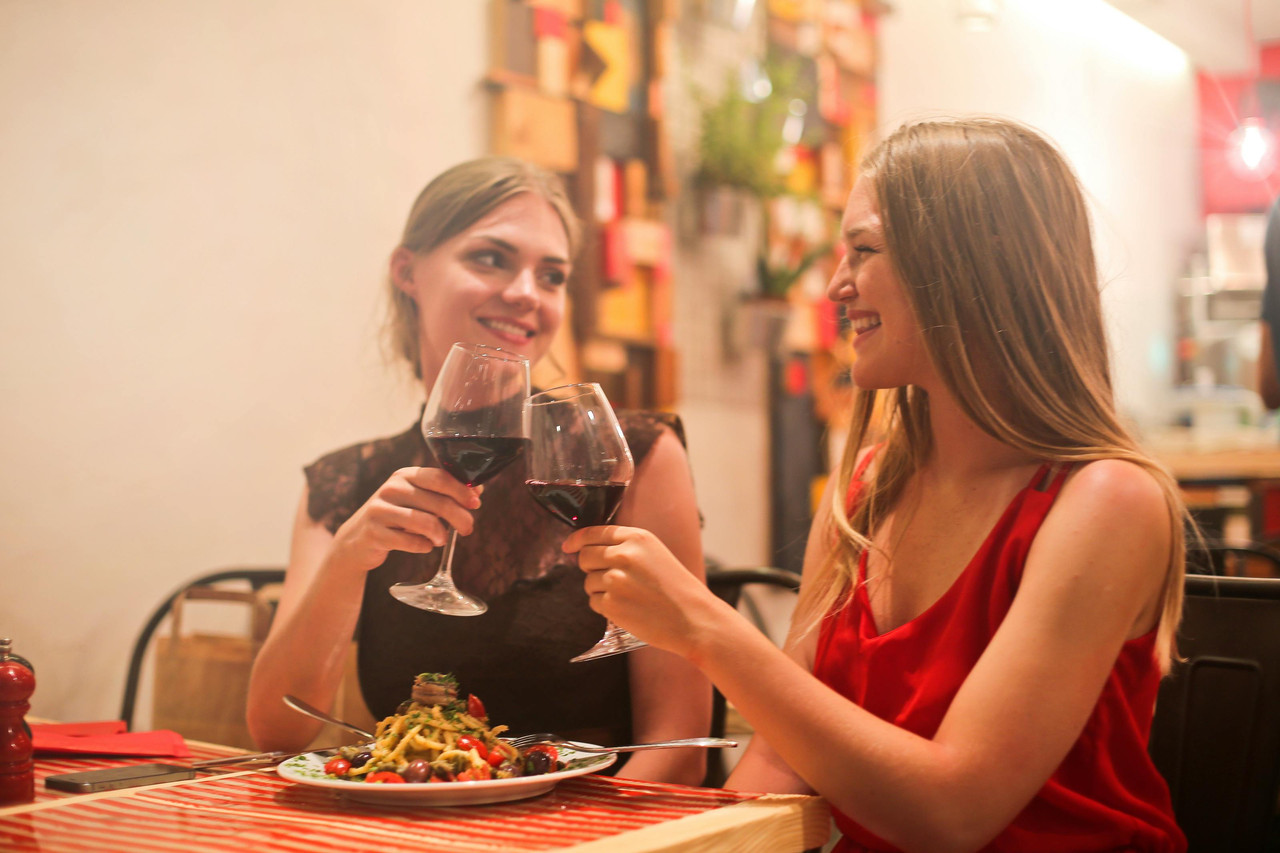
Adding alcohol into the mix means some of your daily energy intake is coming from a drink rather than food.
Alcohol provides around 7 kcal (29 kJ) per gram, so it can contribute a meaningful amount of energy without providing the protein, fibre and micronutrients you may be trying to prioritise during weight loss.
The goal isn't to tell you:
"Never drink."
It's to help you understand the trade-offs so you can make alcohol fit your life without letting it regularly derail your nutrition, training and recovery.
Why Alcohol Can Make GLP-1 Weight Loss Harder
There are several different things going on.
1. Alcohol contains calories
Alcohol contains 29 kJ (7 calories) per gram with zero nutritional value. If you are tracking your overall daily intake, factor this into your daily calorie deficit calculator.
This is the obvious one.
A drink contributes energy to your overall intake, whether it comes from wine, beer, spirits or a cocktail.
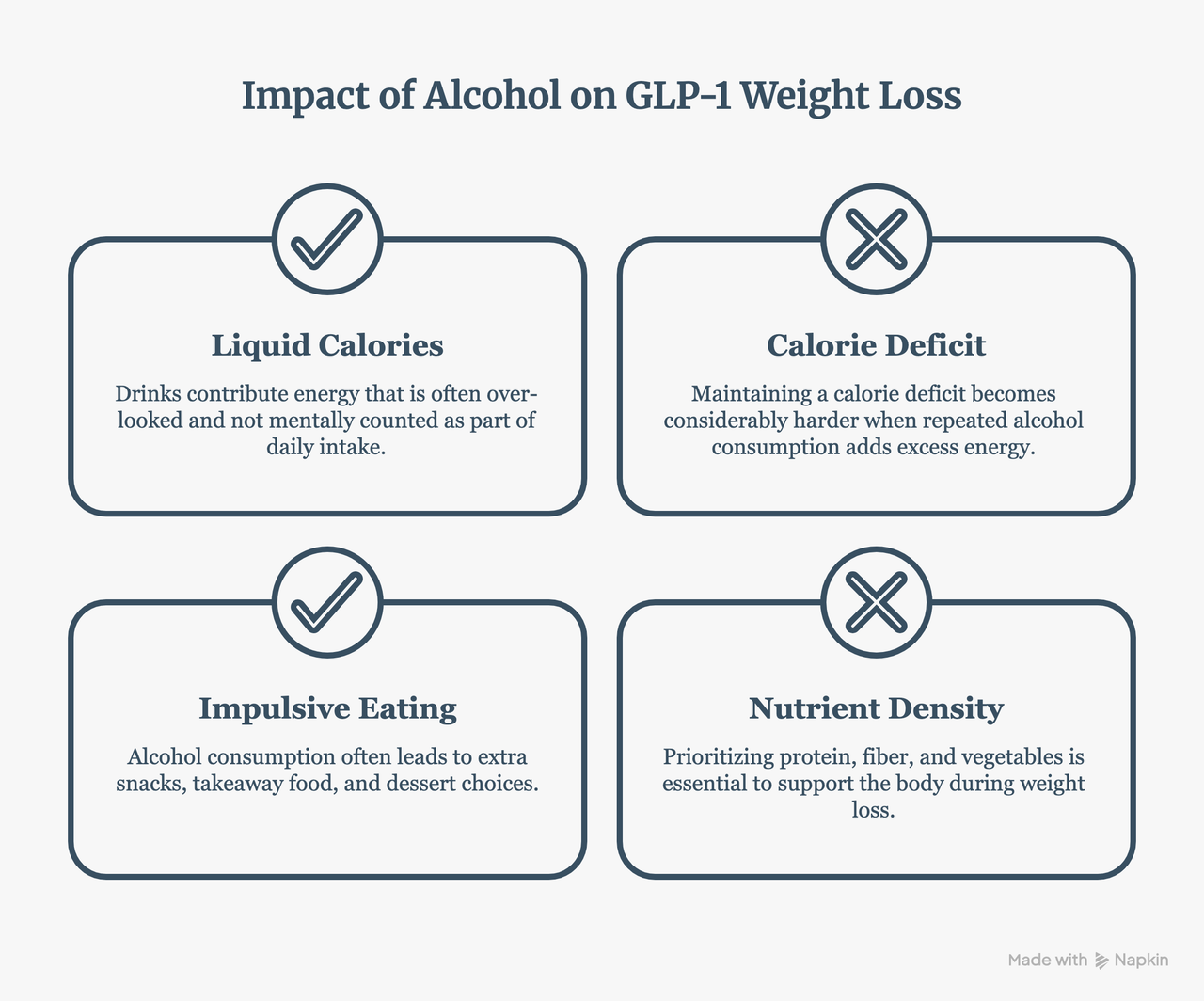
The problem is that liquid calories can be easy to overlook.
You might have a normal dinner, then add two or three drinks afterwards without mentally counting them as part of the day's intake.
Over a single night, that may not matter much.
Repeated every weekend, it can make maintaining a calorie deficit considerably harder.
Research on alcohol and body weight is mixed, but alcohol provides substantial energy and higher levels of consumption can contribute to excess energy intake and weight gain.
2. Alcohol can affect what you eat
For many people, the bigger issue isn't the drink itself.
It's everything that happens around it.
A few drinks can become:
- Chips before dinner
- Extra snacks
- Takeaway on the way home
- Dessert
- A second dinner
- "I'll start again Monday"
That is where a relatively small amount of alcohol can turn into a much larger calorie surplus.
And if you're already eating less because of a GLP-1, there's another issue.
You don't just want to reduce calories.
You want to make sure the calories you do eat are helping support your body during weight loss.
That means protein, fruit and vegetables, fibre, fluids and other nutrient-dense foods still need to get a look in.
Alcohol and the GLP-1 Appetite Effect
One of the more interesting developments in GLP-1 research is what happens to alcohol itself.
Some people taking GLP-1 medications report that they simply want to drink less.
And there is now emerging clinical evidence to support the idea that GLP-1 receptor agonists may influence alcohol craving and consumption.
A 2025 randomised clinical trial found that low-dose semaglutide reduced some measures of alcohol consumption and craving in adults with alcohol use disorder, although it did not reduce every measure of drinking.
A larger 2026 randomised trial in people with alcohol use disorder and obesity also found that semaglutide reduced heavy drinking days compared with placebo.
However, this research is still developing.
It does not mean that Ozempic, Wegovy or Mounjaro will automatically make everyone lose interest in alcohol.
And it certainly doesn't mean GLP-1 medication should be used as a treatment for alcohol use disorder outside appropriate medical care.
The practical takeaway is much simpler:
If you notice that you naturally want fewer drinks after starting a GLP-1, that's something you can work with rather than fight against.
Can Alcohol Feel Different on a GLP-1?
It can.
GLP-1 medications such as semaglutide can delay gastric emptying, and nausea, vomiting, abdominal discomfort, reflux and other gastrointestinal effects are recognised adverse effects.
Alcohol can also affect the gastrointestinal system.
So if you've already noticed that certain foods, larger meals or eating quickly make you feel uncomfortable on your medication, alcohol may not feel exactly the same as it did before.
There isn't a universal rule that says:
"Alcohol is dangerous with GLP-1 medication."
But there also isn't a good reason to assume your tolerance will be exactly the same.
Your response can depend on:
- Your medication
- Your dose
- How recently your dose changed
- How much you drink
- Whether you've eaten
- Your hydration
- Your individual GI symptoms
- Other medications or health conditions
If alcohol consistently causes significant nausea, vomiting, abdominal pain, dizziness or other concerning symptoms, don't try to push through it. Speak with your healthcare professional.
What About Hangovers on a GLP-1?
This is where individual experience matters.
There isn't good evidence to say that a GLP-1 automatically causes worse hangovers or that alcohol sits in your stomach for twice as long.
What we do know is that GLP-1 medications can affect gastric emptying and commonly cause gastrointestinal symptoms, while alcohol can contribute to dehydration and disrupt sleep.
So the combination may simply feel worse for some people, particularly if they are already struggling with nausea, poor appetite or hydration.
That is a good reason to pay attention to how your body responds rather than assuming that because you tolerated three or four drinks before starting medication, you'll tolerate them the same way now.
Alcohol, Sleep and Recovery
This is one of the most overlooked parts of the equation.
Alcohol can make you feel sleepy and may help you fall asleep faster, but that doesn't necessarily mean you're getting better sleep.
A 2025 systematic review and meta-analysis of 27 studies found that alcohol altered sleep architecture, including delaying and reducing REM sleep. Effects were seen even at relatively low doses and became more pronounced as alcohol intake increased.
Why does that matter for fat loss?
Because your results aren't created by your calorie target alone.
You're also trying to:
- Train consistently
- Recover
- Maintain strength
- Manage appetite
- Make sensible food choices
- Have enough energy to get through the week
If drinking regularly leads to poor sleep, that can make the next day harder.
And if Friday night drinking turns into:
Poor sleep → takeaway → missed training → low energy → poor food choices
the issue is no longer simply the calories in the drinks.
It's the ripple effect.
What About Alcohol and Muscle Preservation?
This is particularly relevant if you're using a GLP-1 for weight loss.
One of the goals at WRK isn't simply to make the number on the scales smaller.
It's to help you lose fat while supporting the strength and muscle you want to keep.
Alcohol can complicate that picture.
Excess alcohol directly blunts muscle protein synthesis. To protect lean mass while on Ozempic or Wegovy, focus on adequate protein intake and a structured GLP-1 strength training routine.
Research in exercise settings has found that high doses of alcohol consumed after strenuous exercise can reduce muscle protein synthesis during recovery. One controlled human study used a very large alcohol dose—around 12 standard drinks—so it should not be interpreted as proof that one or two drinks will cause meaningful muscle loss.
The more useful takeaway is:
If muscle preservation is a priority, regularly pairing heavy drinking with your hardest training sessions isn't a great strategy.
Your bigger priorities remain:
LIFT: Resistance training
EAT: Adequate protein and nutrition
SUPPORT: Recovery, hydration and sustainable habits
Alcohol doesn't automatically cancel those things.
But excessive drinking can make all three harder to execute well.
How to Drink Alcohol Without Derailing Your GLP-1 Progress
You don't need a perfect strategy.
You need one that works in the real world.
1. Decide Before You Start
Make the decision about how much you're going to drink before you've started drinking.
It's much easier to make a deliberate decision when you're sober than halfway through the evening.
You can also decide in advance whether you're drinking at all.
2. Track Standard Drinks, Not Just Glasses
This is particularly important in New Zealand.
One standard drink contains 10g of pure alcohol.
Roughly, that's:
- 330ml of 4% beer or cider
- 100ml of 12.5% wine
- 30ml of 42% spirits
A large wine pour or generous spirit measure can easily contain more than one standard drink.
So "I only had three drinks" doesn't necessarily tell you how much alcohol you actually consumed.
Look at the label or estimate the standard drinks rather than simply counting glasses.
3. Eat Before You Drink
Going out hungry is rarely a great strategy for fat loss.
And on a GLP-1, there is an additional reason to think about this.
If your appetite is already low, you don't want alcohol replacing a meal that would have provided protein and other useful nutrients.
Before drinking, consider having a proper meal containing:
- A good protein source
- Vegetables or fruit
- A source of carbohydrate
- Some healthy fat
You don't need to "save calories" by starving yourself beforehand.
4. Prioritise Protein Before the Drinks
This is a particularly useful strategy for GLP-1 users.
If your appetite is suppressed, protein is already something you need to be intentional about.
So rather than thinking:
"I'll skip dinner because I'm drinking tonight."
Think:
"I'll make sure I've got a decent protein-rich meal in first."
That helps prevent alcohol from displacing one of the nutrients you're trying hardest to prioritise.
5. Choose Drinks That Are Easier to Account For
There is no magic "weight-loss alcohol."
But some drinks are easier to fit into a calorie-controlled diet than others.
A large sugary cocktail can contain considerably more energy than a smaller, simpler drink.
Think about:
- Portion size
- Alcohol percentage
- Mixers
- Added sugar
- Number of standard drinks
The goal isn't to find a "healthy" alcoholic drink.
It's to make the energy contribution easier to understand.
6. Alternate With Water
Water doesn't cancel out alcohol.
But alternating alcoholic drinks with water can slow the pace of drinking and help you maintain your fluid intake.
Health New Zealand also recommends having non-alcoholic drinks before and between alcoholic drinks and having your first drink after starting to eat. :contentReference[oaicite:8]{index=8}
This is particularly relevant if you're already struggling with hydration while taking a GLP-1.
7. Have a Plan for the Food Afterwards
This is a big one.
If you know that drinking usually ends with:
"Let's get a kebab."
don't rely on your late-night decision-making.
Have something planned.
It doesn't have to be perfect.
The objective is simply to avoid turning a few drinks into an entire evening of uncontrolled eating.
A Simple GLP-1 Alcohol Strategy
If you're going out for drinks, think:
| Before drinking | While drinking | After drinking |
|---|---|---|
| Eat a protein-rich meal | Slow the pace | Drink water |
| Don't arrive starving | Track standard drinks | Avoid the "stuff it, I'll restart Monday" mindset |
| Hydrate | Alternate with water | Get back to normal eating |
| Know your limit | Pay attention to symptoms | Prioritise sleep and recovery |
It's not about making alcohol "healthy."
It's about managing the consequences.
What If Alcohol Makes Me Nauseous on a GLP-1?
Don't force it.
If alcohol consistently makes your nausea, reflux, vomiting, abdominal discomfort or other symptoms worse, reducing or avoiding alcohol may be the sensible choice.
And if you're experiencing significant vomiting or can't keep fluids down, your priority isn't hitting your calorie or protein target.
It's hydration and appropriate medical care.
Talk to your prescribing healthcare professional if you're having persistent or severe symptoms.
How Much Alcohol Can I Have on a GLP-1?
There isn't a universal GLP-1-specific number that applies to everyone.
Your medication, health history, other medicines, alcohol tolerance and individual response all matter.
For general alcohol risk reduction in Aotearoa New Zealand, Health New Zealand advises:
- At least 2 alcohol-free days each week
- No more than 10 standard drinks per week for women
- No more than 15 standard drinks per week for men
- No more than 4 standard drinks at one time for women
- No more than 5 standard drinks at one time for men
These are lower-risk guidelines, not a guarantee of no harm, and they are not a personalised recommendation for someone taking a GLP-1. :contentReference[oaicite:9]{index=9}
If your healthcare professional has advised you to avoid alcohol because of your medication or another health condition, follow that advice.
Do You Need to Give Up Alcohol to Lose Weight?
No.
But here's the more useful question:
Does the way you currently drink make your goal harder?
For some people, one or two drinks with dinner occasionally have very little impact.
For others, drinking means:
Friday night drinks → takeaway → poor sleep → Saturday fatigue → missed training → more food → Sunday recovery → Monday reset.
If that's your pattern, the problem isn't simply the alcohol calories.
It's the behavioural ripple effect.
And that's where reducing alcohol can make a significant difference.
Think About Alcohol as Part of the Bigger Picture
Weight loss isn't about creating a perfect diet that contains nothing enjoyable.
It's about creating a system you can actually live with.
That means understanding trade-offs.
You can have the wine.
You can have the beer.
You can go out with your friends.
But if you're using a GLP-1, your appetite may already be giving you less room to work with.
So make the food you do eat count.
Prioritise protein.
Keep resistance training consistent.
Stay hydrated.
Protect your sleep.
And don't let one social night turn into a three-day write-off.
That's a much more useful strategy than pretending alcohol doesn't matter—or deciding you can never drink again.
The WRK Approach: LIFT. EAT. SUPPORT.
This is where alcohol fits into the broader WRK approach.
LIFT
Keep resistance training consistent so you're giving your muscles a reason to stay during weight loss.
EAT
Prioritise protein and nutrient-dense food, particularly when your appetite is reduced.
SUPPORT
Manage hydration, sleep, recovery, social situations and the practical side effects that can make life on a GLP-1 more complicated.
Alcohol sits inside SUPPORT.
It isn't automatically forbidden. But it is another variable you need to understand.
Yes, you can still lose weight and drink alcohol while using a GLP-1.
You don't need to choose between making progress and having a social life.
But alcohol can make the process harder by adding energy, influencing food choices, disrupting sleep and potentially making hydration, GI symptoms and recovery more difficult.
For GLP-1 users, there's an additional consideration:
Your appetite is already reduced.
That means your available food intake is valuable.
###Use it wisely. ###Get your protein. ###Eat nutritious food. ###Train your muscles. ###Drink enough fluids.
And if you choose to drink, do it deliberately rather than letting a few drinks turn into an entire weekend off track.
The goal isn't perfection.
It's building a way of losing weight that you can actually live with.
Want Help Making GLP-1 Weight Loss Fit Your Real Life?
You don't need another diet that tells you to eliminate everything you enjoy.
You need a strategy that helps you lose the weight while protecting your strength, nutrition and long-term fitness.
Start with the WRK GLP-1 Weight Loss Safety Assessment to identify the areas that may be holding your progress back.
**[Apply for Online Coaching →]
Medical Disclaimer
This article provides general educational information and is not a substitute for individual medical advice, diagnosis or treatment. GLP-1 medications are prescription medicines and should be used under the supervision of an appropriately qualified healthcare professional. Alcohol may be inappropriate for some people because of medical conditions, medication interactions or individual circumstances. If you are unsure whether alcohol is appropriate for you, speak with your prescribing healthcare professional. If you experience severe or persistent vomiting, significant abdominal pain, difficulty maintaining hydration or other concerning symptoms, seek appropriate medical care.
Sources
- Health New Zealand — Drinking responsibly and standard drinks.
- Health New Zealand — Eating well for good health.
- Health New Zealand — Getting enough to drink.
- PubMed — Alcohol consumption and body weight: systematic review.
- PubMed — Effect of alcohol on subsequent sleep: systematic review and meta-analysis.
- PubMed — Alcohol ingestion and post-exercise muscle protein synthesis.
- JAMA Psychiatry — Randomised clinical trial of semaglutide and alcohol consumption.
- The Lancet — Randomised trial of semaglutide in alcohol use disorder with obesity.
Common Inquiries on this Topic
Can you drink alcohol on Ozempic?
There isn't a universal rule that everyone taking Ozempic must avoid alcohol. However, alcohol can add calories and may worsen gastrointestinal symptoms, dehydration or other issues for some people. Your individual medical circumstances and other medications matter, so speak with your prescriber if you're unsure.
Can you drink alcohol on Wegovy?
Some people taking Wegovy can still drink alcohol, but individual tolerance varies. Wegovy commonly causes gastrointestinal side effects and delays gastric emptying, so alcohol may not feel the same as it did before treatment. If drinking causes significant nausea, vomiting or other concerning symptoms, stop and speak with your healthcare professional.
Can you drink alcohol on Mounjaro?
If you're taking Mounjaro, whether alcohol is appropriate depends on your individual health circumstances, medication regimen and how you respond to both the medication and alcohol. Alcohol can also make it harder to manage calorie intake, hydration, sleep and recovery.
Does alcohol stop weight loss on a GLP-1?
No. Alcohol does not automatically stop weight loss. However, it contributes energy and can make maintaining a calorie deficit harder. The bigger issue for some people is the combination of alcohol, extra food, poor sleep and reduced activity that can follow a night of drinking.
Does alcohol make GLP-1 side effects worse?
It can for some people, particularly if they already experience nausea, reflux, abdominal discomfort or dehydration. There isn't a single response that applies to everyone. Pay attention to your symptoms and speak with your healthcare professional if alcohol consistently makes them worse.
Can GLP-1 medications reduce your desire to drink alcohol?
Possibly. Emerging research suggests GLP-1 receptor agonists may reduce alcohol craving and some measures of alcohol consumption in certain people. However, the research is still developing and GLP-1 medications should not be considered a general treatment for alcohol use disorder without appropriate medical supervision. :contentReference[oaicite:11]{index=11}
Is wine better than beer for weight loss?
Not automatically. The important factors are the amount of alcohol, serving size, alcohol percentage and any additional calories from mixers or other ingredients. A large wine pour can contain more than one standard drink, just as a large or strong beer can.
Should I drink alcohol before or after training?
If muscle preservation and training quality are priorities, regularly combining heavy alcohol intake with hard training isn't a good strategy. Research has found that high doses of alcohol after strenuous exercise can impair aspects of muscle protein synthesis and recovery. Never, drink prior to exercise.
Do I need to quit alcohol completely to lose weight?
No. Some people can include occasional alcohol and continue to lose weight. If alcohol regularly leads to overeating, poor sleep, missed training or several days of being off routine, however, reducing your intake may make your progress considerably easier.
References & Clinical Sources
References
- Healthify. Alcohol – general information. :contentReference[oaicite:3]{index=3}
- CHEERS / Alcohol and Me. Standard drinks. :contentReference[oaicite:4]{index=4}
- Heart Foundation New Zealand. Alcohol position statement. :contentReference[oaicite:5]{index=5}
- NauMai NZ. Alcohol laws and drinking responsibly. :contentReference[oaicite:6]{index=6}
- HealthEd / Health New Zealand. Standard drinks symbol. :contentReference[oaicite:7]{index=7}
H. Richards
Personal TrainerWith over 20 years of experience coaching high performers, H. Richards delivers precision training frameworks built on evidence and practical application. His approach cuts through the noise to help you achieve sustainable results, backed by consistently excellent 5-star client reviews.
Explore Coaching ProgramsIf you want help building a realistic fat loss plan that works with your actual life, not an ideal version of it, getting the right structure makes a big difference.
Take our 2-minute assessment to evaluate your current protein intake and training consistency.
Take the Free AssessmentRelated Guides & Protocols
 General
How Often Should You Train for Fat Loss?
If you want to lose fat, you do not need to train every day. For most adults, the best results come from a realistic mix of strength training, daily movement, and nutrition that supports a calorie deficit. That can be done consistently.