What Is a GLP-1 and How Does It Actually Work for Weight Loss?
"GLP-1 medications like Ozempic and Mounjaro curb appetite and lower blood sugar, but rapid weight loss carries an unspoken cost: lean muscle loss. Discover how GLP-1s work and the non-negotiable habits required to protect your strength."
If you are researching or currently taking medications like Ozempic, Wegovy, or Mounjaro, you already know they make eating less feel remarkably effortless.
Watching the numbers on the bathroom scales tick downward week after week provides an undeniable rush of validation. However, losing body weight and losing body fat are not the same thing. Without a deliberate physical strategy, rapid scale drops often conceal an underlying trade-off: the involuntary loss of metabolically active muscle tissue.
Key Takeaway: A GLP-1 receptor agonist is a medication that mimics the gut hormone glucagon-like peptide-1. It promotes weight loss by slowing gastric emptying, stimulating insulin, and signaling satiety to the brain. To prevent companion muscle loss, it must be paired with structured resistance training and adequate dietary protein.
What Is a GLP-1 Receptor Agonist?
A GLP-1 receptor agonist is a class of medication designed to copy the actions of naturally occurring incretin hormones produced in your intestines. Originally formulated to help adults manage type 2 diabetes, medications such as semaglutide (Ozempic, Wegovy) and dual GIP/GLP-1 agonists like tirzepatide (Mounjaro, Zepbound) are now widely prescribed for chronic weight management.
Under ordinary physiological conditions, your gut releases natural GLP-1 shortly after you eat. This peptide signals your pancreas to release insulin, suppresses the release of glucagon, and communicates directly with your brain to tell you that you are satisfied.
Synthetic GLP-1 medications bind to those same cellular receptors across your digestive tract and central nervous system. The difference is longevity: while your body breaks down natural gut hormones within minutes, pharmaceutical receptor agonists remain active for days, providing sustained appetite suppression and steady glycaemic control.
How Does a GLP-1 Actually Drive Weight Loss?
GLP-1 medications do not magically burn fat from your frame; they induce weight loss by creating a substantial, involuntary calorie deficit.
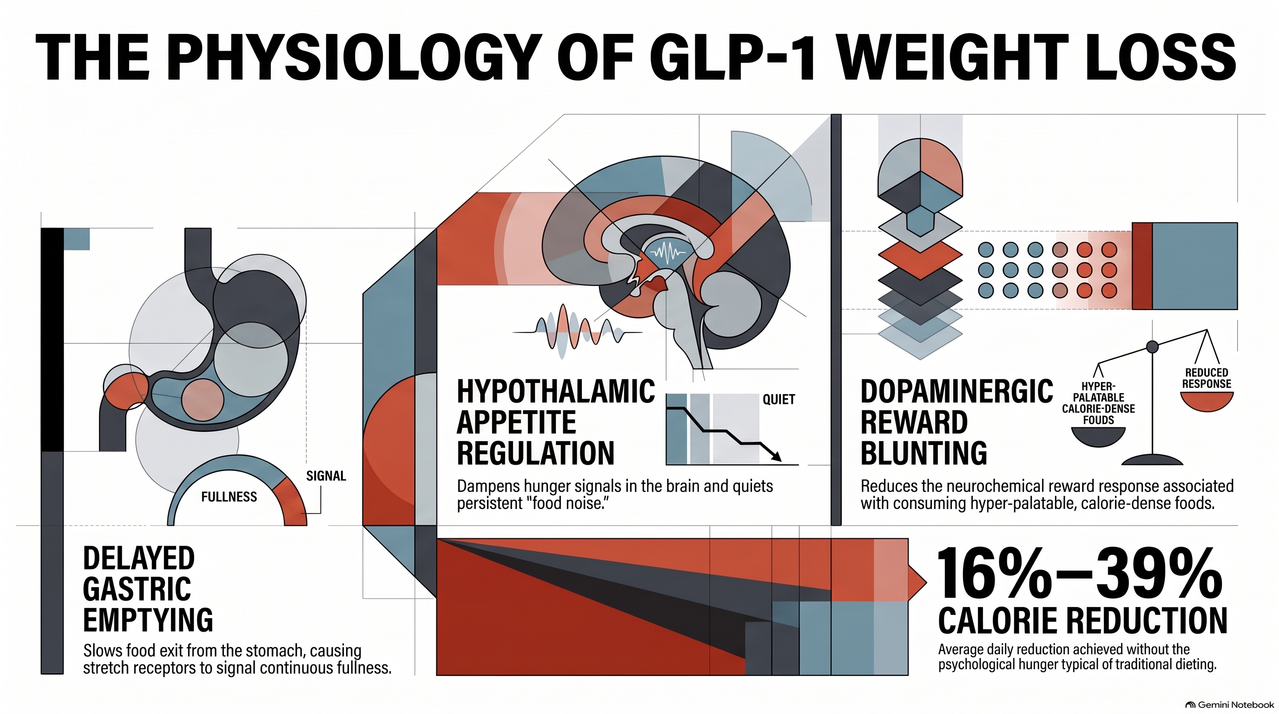
They achieve this energy deficit through three primary physiological mechanisms:
- Delayed Gastric Emptying: The medication slows the speed at which food leaves your stomach. By keeping food physically present in your gastric system longer, stretch receptors continuously signal to your brain that you are full.
- Hypothalamic Appetite Regulation: GLP-1 molecules cross into appetite control centers within the brain, including the hypothalamus and brainstem. This directly dampens hunger signals and quiets constant thoughts about food (often described as "food noise").
- Dopaminergic Reward Blunting: Incretin mimetics alter signaling in the mesolimbic reward system. This reduces the neurochemical reward response associated with consuming hyper-palatable, calorie-dense foods high in sugar and refined fats.
Together, these mechanisms lead most people to consume between 16% and 39% fewer daily calories without the intense psychological hunger typically triggered by traditional dieting.
The Unspoken Trade-off: Scale Weight vs. Lean Muscle Mass
When energy intake drops drastically, your body has to make up the difference by breaking down internal tissues for fuel. The hard truth of clinical weight loss is that your body does not draw energy exclusively from fat stores.
Clinical trial sub-analyses from programs like STEP (semaglutide) and SURMOUNT (tirzepatide) show that lean mass accounts for approximately 25% to 40% of total weight lost when lifestyle interventions are unguided. While "lean mass" includes body water and connective tissues alongside skeletal muscle, losing functional muscle tissue carries serious long-term consequences.
| Weight Loss Component | Typical Proportion | Clinical Consequence |
|---|---|---|
| Fat Mass Lost | ~70% to 75% | Improved cardiovascular and metabolic markers. |
| Lean Mass Depleted | ~25% to 30% | Reduced functional capacity and a drop in resting metabolic rate. |
Unmonitored muscle loss sets the stage for sarcopenic obesity—a condition where an individual reaches a lighter scale weight or lower BMI, but carries a higher relative body fat percentage and reduced muscular capacity.
Skeletal muscle acts as your primary metabolic engine and glucose sink. Losing muscle reduces your resting metabolic rate, impairs joint stability, compromises bone density, and leaves you metabolically vulnerable to rapid weight rebound if you ever stop or reduce the medication.
Why Cardio Alone Fails on a GLP-1
When adults see the scales stalling or want to accelerate their results, the default reaction is usually to add excessive cardiovascular exercise: daily runs, long stationary bike rides, or high-intensity interval classes. On a GLP-1, this strategy often backfires.
Cardiovascular exercise improves cardiorespiratory fitness, but it does not provide the necessary mechanical tension to preserve skeletal muscle during a steep energy deficit.
| Training Modality | Acute Physiological Impact | Long-Term Adaptations on a Deficit | Impact on Lean Muscle & Metabolism |
|---|---|---|---|
| High-Volume Aerobic Cardio Alone | Burns calories during the session; increases systemic fatigue and elevates recovery demands. | Lowers mechanical muscle tension; increases catabolic signalling when energy availability is low. | Accelerates lean mass loss; reduces resting metabolic rate and functional strength. |
| Progressive Resistance Training | Generates high mechanical tension; recruits high-threshold motor units across major muscle groups. | Directs nutrient partitioning toward muscle repair; signals the nervous system to retain contractile tissue. | Preserves skeletal muscle mass; maintains resting metabolic rate and physical capacity. |
When you operate in a deep calorie deficit caused by medication, adding high volumes of cardio increases systemic stress and catabolic signaling. Without high-threshold motor unit recruitment from lifting weights, your body has no physiological incentive to hold on to energy-expensive muscle tissue.
The outcome? You end up smaller, but noticeably weaker, with softer muscle tone and an increasingly sluggish metabolic rate.
The 3 Non-Negotiables While on the Shot
To ensure you lose pure body fat rather than functional tissue, you must treat your injection as one half of a complete protocol. The prescription manages your appetite; your daily habits protect your body composition.
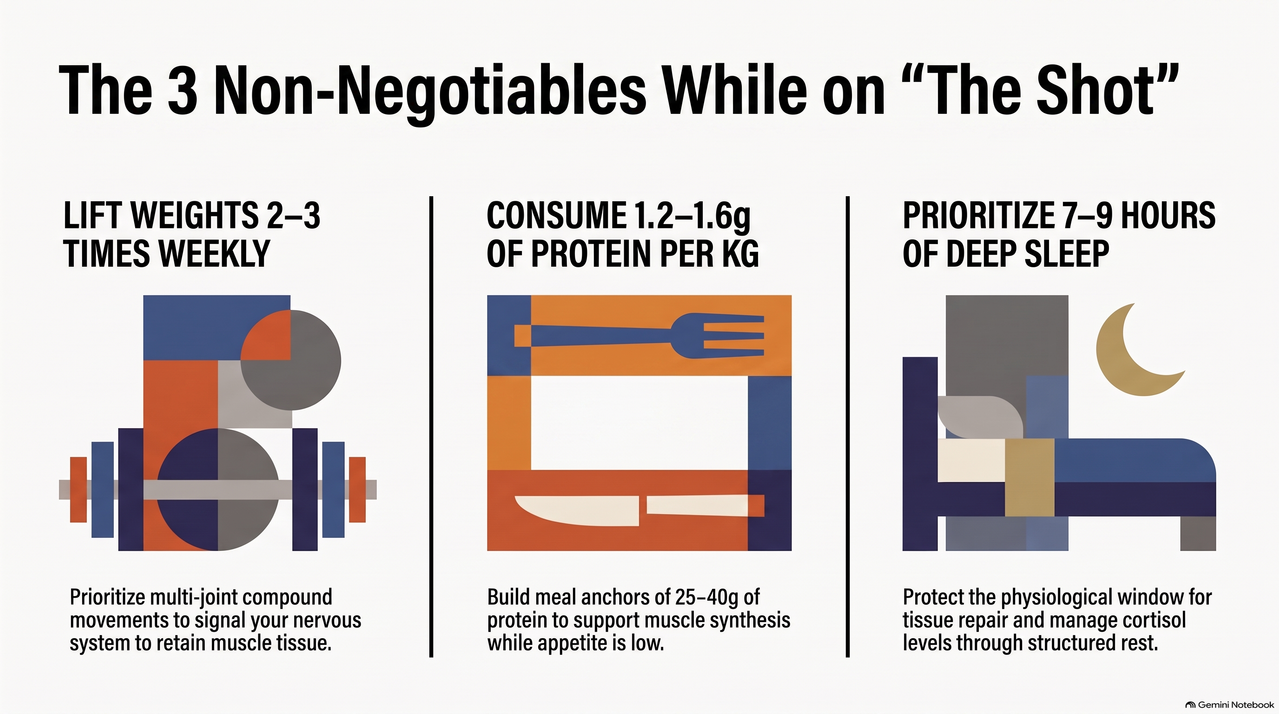
1. Progressive Resistance Training (Lift 2–3 Times Weekly)
Resistance exercise provides the direct mechanical stimulus required to counteract the catabolic effects of a calorie deficit. Lifting weights tells your nervous system: "Keep this tissue—we need it."
- Focus on the core movement patterns: Prioritise multi-joint compound exercises: squats, hip hinges, presses, rows, and loaded carries.
- Train for tension, not exhaustion: Perform 2 to 4 working sets of 8 to 12 repetitions per exercise. Choose a weight that leaves 1 to 2 clean repetitions in reserve before failure.
- Track progressive overload: Strive to add slight resistance, improve movement tempo, or complete an additional repetition each week.
2. Prioritised Protein Anchors (1.2–1.6 g/kg Minimum)
Because appetite suppression makes large meals unappealing, you must be intentional about nutrient density. Eating enough dietary protein supplies the essential amino acids needed to support muscle protein synthesis.
- Establish your baseline target: Aim for roughly 1.2 to 1.6 grams of protein per kilogram of target body weight daily. For an individual with a goal weight of 80 kg, that means targeting 96 to 128 grams per day.
- Build meal anchors: Divide your total across the day into 3 to 4 feedings containing 25 to 40 grams of high-quality protein (e.g., eggs, chicken tenderloins, Greek yoghurt, cottage cheese, tofu, or lean fish).
- Use convenience tools when necessary: When solid food feels too heavy, rely on a 20 to 30 g whey isolate or pea protein shake to hit your targets without overwhelming your stomach.
3. Structured Recovery and Sleep Optimization
A steep calorie deficit coupled with delayed digestion places subtle stress on your central nervous system. Without adequate recovery, systemic cortisol levels rise, which can further accelerate muscle breakdown and trigger fluid retention.
- Protect deep sleep: Aim for 7 to 9 hours of quality sleep nightly. Slow-wave deep sleep is the primary physiological window for nightly tissue repair and growth hormone release.
- Space your meals: Avoid consuming large, heavy meals within 2 to 3 hours of bed to prevent gastrointestinal discomfort from delayed stomach emptying.
- Honor active rest: Separate lifting sessions with dedicated recovery days, prioritizing low-stress daily movement like leisurely walking rather than grueling cross-training.
A GLP-1 medication is a potent medical lever that curbs appetite, manages blood sugar, and simplifies the math of weight loss. But the shot cannot lift weights for you, it cannot prioritise your protein, and it cannot protect your functional capacity.
The real objective is never simply to become a smaller version of yourself. The goal is to build a leaner, stronger, and more capable body that serves you for decades to come.
Common Inquiries on this Topic
Does Ozempic or Mounjaro cause direct muscle wasting?
No. GLP-1 medications do not contain any pharmacological property that actively destroys muscle tissue. The loss of lean mass is the natural physiological consequence of a rapid, unmonitored calorie deficit combined with inadequate protein and an absence of resistance training.
How many days per week should I lift weights while on a GLP-1?
Two to three full-body strength sessions per week are ideal for most adults. Focusing on fundamental human movement patterns (squatting, hinging, pushing, pulling, and carrying) provides the necessary stimulus to maintain muscle without overwhelming your recovery capacity.
What should I eat if I have zero appetite?
Prioritise nutrient-dense, low-volume foods that are easy to digest. High-protein yoghurt, soft eggs, cottage cheese, tofu, and whey protein smoothies allow you to hit your vital amino acid targets without feeling uncomfortably full or nauseous.
Take the Next Step in Your Journey
Protecting your metabolic health requires a clear plan tailored to how your body is changing. If you want objective feedback on whether your current routine is safeguarding your strength:
- Check your baseline risk with the free fitness assessment.
- Learn more about individualised exercise programming with 1-on-1 personal training in Christchurch.
- Prefer to train remotely with structured programming and weekly accountability? Explore our evidence-based online coaching.
H. Richards
Personal TrainerWith over 20 years of experience coaching high performers, H. Richards delivers precision training frameworks built on evidence and practical application. His approach cuts through the noise to help you achieve sustainable results, backed by consistently excellent 5-star client reviews.
Explore Coaching ProgramsTake the Free GLP-1 Fitness Assessment
Take our 2-minute assessment to evaluate your current protein intake and training consistency.
Take the Free Assessment