TDEE vs BMR: What's the Difference and Which One Actually Matters for Fat Loss
"Understand the difference between BMR and TDEE and why it matters even more when you're using a GLP-1. Learn how to set a sensible calorie target while prioritising protein, muscle, training and sustainable fat loss."
TDEE vs BMR: How to Set Your Calorie Target on a GLP-1
TDEE vs BMR: What's the Difference and Which One Actually Matters for Fat Loss?
If you've ever used a calorie calculator, you've probably seen two numbers:
BMR and TDEE.
They're related, but they aren't the same thing—and confusing the two can lead to an unnecessarily aggressive calorie target.
This becomes particularly important when you're taking a GLP-1 medication such as Ozempic, Wegovy or Mounjaro.
Your calorie needs don't suddenly disappear because your appetite has changed.
But your ability to eat enough to support your health, training and muscle can change significantly.
That's why understanding your energy needs matters.
What Is BMR?
BMR stands for Basal Metabolic Rate.
It's an estimate of the energy your body needs to perform its basic physiological functions at rest.
Think:
- Breathing
- Circulation
- Maintaining body temperature
- Supporting your organs
- Keeping your brain functioning
- Basic cellular processes
Your BMR is essentially the energy your body would require if you were resting and doing very little physical activity.
It is not the number of calories you should automatically eat every day.
One of the most commonly used equations for estimating BMR is the Mifflin-St Jeor equation, which uses factors such as your age, sex, height and body weight.
But remember:
BMR is an estimate, not a measurement of your actual metabolism.
What Is TDEE?
TDEE stands for Total Daily Energy Expenditure.
This is a much more useful number when you're trying to understand how many calories you need to maintain your current body weight.
Your TDEE includes the energy you use from:
- Your basal metabolism
- Walking and everyday movement
- Exercise
- Work and physical activity
- Digestion
- Other normal daily activity
In simple terms:
BMR = what your body needs at rest.
TDEE = what your body approximately uses across your actual day.
Your TDEE will generally be higher than your BMR.
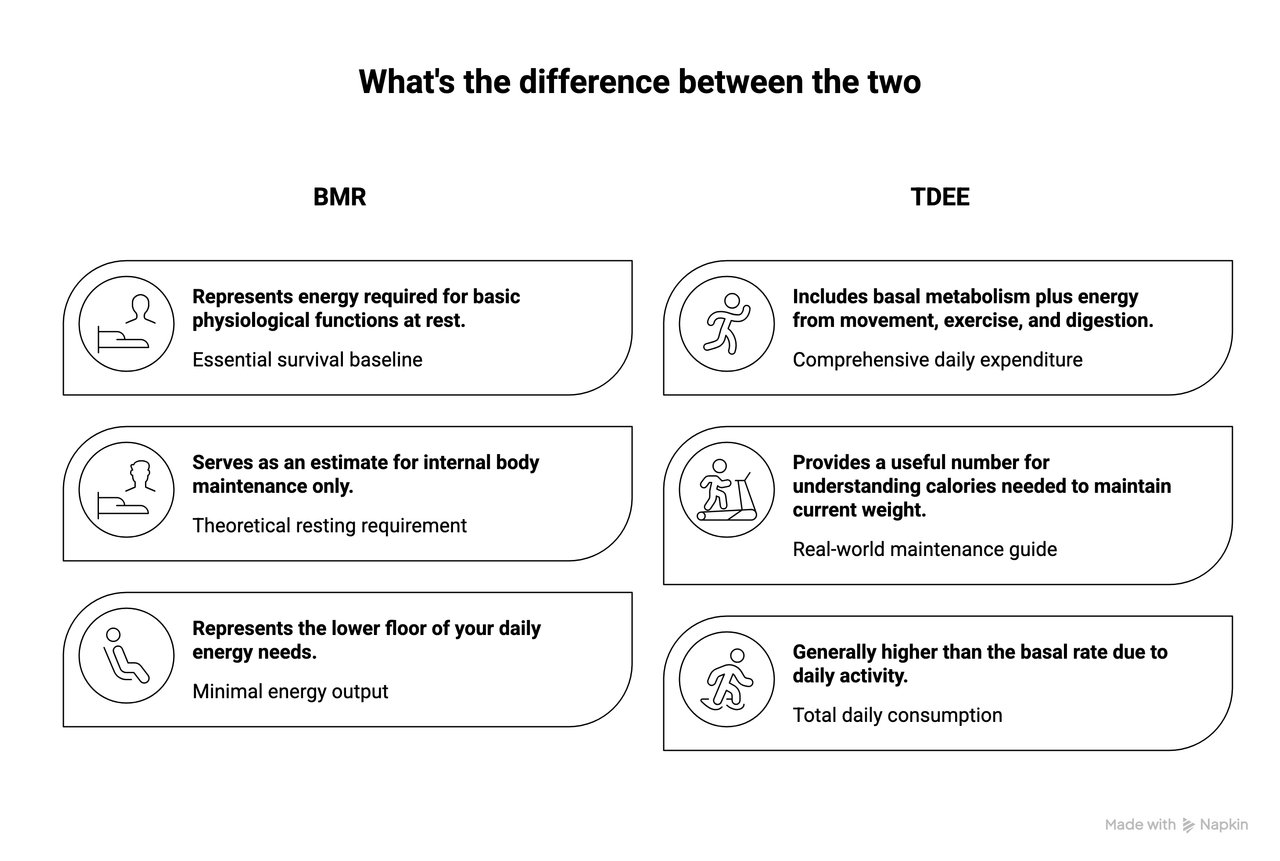
BMR vs TDEE: What's the Difference?
| BMR | TDEE | |
|---|---|---|
| What it measures | Energy required at rest | Estimated total daily energy expenditure |
| Includes daily movement | No | Yes |
| Includes exercise | No | Yes |
| Includes digestion | No | Yes |
| Useful for setting a fat-loss target | Limited | Yes |
| Changes with activity | Less directly | Yes |
The simplest way to remember it:
BMR is part of your energy expenditure. TDEE is the bigger picture.
Calculate both your basal metabolic rate and total daily expenditure in seconds using our free NZ TDEE calculator tool.
So Which Number Matters for Fat Loss?
For setting a calorie target, TDEE is the more useful starting point.
If your estimated TDEE is 2,300 calories per day, that represents an estimate of how much energy you use to maintain your current body weight at your current activity level.
To lose weight, you generally need to consume fewer calories than you expend over time.
For example:
Estimated TDEE: 2,300 kcal/day
A moderate starting deficit might produce a target around:
~1,950 kcal/day
The exact deficit should be individualised.
The important point is that you don't need to deliberately eat as close to your BMR as possible to make fat loss happen.
In fact, bigger isn't automatically better when it comes to a calorie deficit.
Why This Matters Even More on a GLP-1
This is where generic calorie advice starts to miss the point.
GLP-1 medications can significantly reduce appetite and food intake.
That can be incredibly useful if you've previously struggled with hunger while trying to lose weight.
But there is another side to that equation.
If your appetite is dramatically reduced, it can become surprisingly easy to eat too little.
And eating less isn't automatically the same as losing weight better.
You still need enough nutrition to support:
- Muscle
- Strength
- Training
- Recovery
- Hydration
- Micronutrient intake
- Normal physiological function
This is why the goal shouldn't be:
"How few calories can I survive on?"
A better question is:
"What's the smallest sensible deficit that allows me to lose fat while still supporting my body?"
You Don't Need to Eat at Your BMR
One of the most common calorie-calculator mistakes is seeing a BMR number and assuming:
"That's the minimum I should eat."
That's not what BMR means.
Your body doesn't stop burning energy once you get out of bed.
You walk.
You work.
You train.
You digest food.
You move around the house.
You climb stairs.
You fidget.
All of this contributes to your total energy expenditure.
That's why your TDEE is generally higher than your BMR.
Your calorie target should be based on your overall energy needs and your goal, rather than simply choosing your BMR as a food target.
What Does BMR × 1.2 Mean?
You may have seen something like:
BMR × 1.2
This is an activity multiplier used to estimate TDEE.
A multiplier around 1.2 represents a largely sedentary lifestyle with relatively little structured activity.
Someone who walks more, has a physically active job or trains regularly would generally use a higher activity estimate.
The problem?
Activity levels are difficult to estimate perfectly.
Two people can both describe themselves as "moderately active" while having very different daily energy expenditure.
That's why any TDEE calculator should be treated as a starting estimate, not a metabolic measurement.
Your real-world weight trend helps tell you whether the starting estimate is close.
How the WRK GLP-1 Calorie & Macro Calculator Works
The GLP-1 Calorie & Macro Calculator is designed to give you a practical starting point rather than simply throwing a BMR number at you.
It estimates your energy requirements and then uses your goal to establish a sensible starting calorie intake.
But there's an important difference in how we approach the numbers.
Calories are not the only target that matters.
When you're using a GLP-1, your appetite may already be significantly reduced.
So instead of simply asking:
"How big can I make my calorie deficit?"
we also need to ask:
"Can I still get enough protein, nutrients and fuel to support my body?"
That's why the calculator builds your macros around protein first, rather than treating protein as whatever calories happen to be left over.
Why Protein Comes Before the Rest of Your Macros
When you're eating fewer calories, every meal has to work harder for you.
Protein becomes particularly important because it provides the amino acids your body needs to maintain and repair muscle tissue.
This is especially relevant during weight loss, when preserving muscle and strength should be part of the goal.
A calorie target without a protein target can therefore leave out an important part of the equation.
At WRK, the approach is:
1. Establish your calorie target
Start with an estimate of your energy needs and apply a sensible deficit.
2. Set protein
Prioritise a protein target appropriate for your body size, activity and goals.
3. Allocate the remaining calories
Once protein is accounted for, the remaining calories can be distributed between carbohydrates and fats according to your preferences, training demands and nutritional needs.
This gives you a much more useful starting point than simply saying:
"Eat X calories."
What If My GLP-1 Has Completely Killed My Appetite?
This is one of the most important situations to recognise.
If your calculated calorie target is 2,000 calories but you're regularly only managing 1,200 because you simply aren't hungry, that doesn't automatically mean you've found a better fat-loss target.
It may mean your appetite suppression is making it difficult to meet your nutritional needs.
You may need to focus on:
- Protein-dense foods
- Nutrient-dense meals
- Smaller portions
- More frequent meals
- Foods that are easier to tolerate
- Adequate fluids
- Managing nausea or other gastrointestinal symptoms
The goal isn't to eat as little as possible.
The goal is to create a sustainable energy deficit while maintaining nutritional adequacy.
If significant appetite suppression, nausea, vomiting or other side effects are preventing you from eating or drinking adequately, discuss this with your prescribing healthcare professional.
Why a Moderate Deficit Can Be Better Than an Aggressive One
It can be tempting to think:
Bigger deficit = faster fat loss.
There is some truth to the first half.
A larger energy deficit can produce faster weight loss in the short term.
But faster isn't automatically better.
A very aggressive deficit can make it harder to:
- Eat enough protein
- Maintain training performance
- Recover properly
- Preserve muscle
- Get adequate nutrients
- Maintain energy
- Sustain the plan long term
And when you're already taking a medication that suppresses appetite, pushing calories unnecessarily low can make those problems even harder to manage.
For many people, a moderate starting deficit is a more practical approach.
The exact amount should depend on the individual rather than following a rigid percentage.
Your TDEE Is Not a Permanent Number
This is another important point.
Your TDEE can change.
If you lose a significant amount of body weight, your energy requirements will generally decrease.
If your activity increases, your energy expenditure can increase.
If you become less active, it can decrease.
Your TDEE is therefore better thought of as a moving estimate rather than a permanent number.
This is why your calorie target should be reviewed as your body, activity and goals change.
How Do You Know If Your Calorie Target Is Working?
Don't judge your calorie target based on a single day—or even a single weigh-in.
Body weight naturally fluctuates because of:
- Water
- Sodium
- Carbohydrate intake
- Food volume
- Bowel contents
- Hormonal changes
- Training
- Hydration
Instead, look at the trend over several weeks.
If your weight is gradually moving in the direction you want, your energy is reasonable and you're able to train and recover, your starting target may be working well.
If nothing is changing over a meaningful period, your activity, food intake and calorie target may need to be reviewed.
If weight is dropping extremely quickly and you're struggling with energy, training, nutrition or other symptoms, the deficit may be too aggressive.
Calories Are One Part of the GLP-1 Equation
This is the biggest shift from traditional calorie-counting advice.
A calorie deficit is necessary for fat loss.
But fat loss isn't the only outcome worth paying attention to.
If you're using a GLP-1, the bigger picture includes:
LIFT
Resistance training to maintain strength and provide your muscles with a reason to stay.
EAT
Adequate calories, protein and nutrient-dense food to support your body while losing weight.
SUPPORT
Hydration, recovery, symptom management and sustainable habits that make the process work in real life.
This is the approach we use at WRK.
BMR and TDEE are useful numbers, but they're not interchangeable.
BMR estimates the energy your body needs at rest.
TDEE estimates your total daily energy expenditure.
For fat loss, TDEE is the more useful starting point for establishing your calorie target.
But if you're taking a GLP-1, there's another layer to consider.
Your appetite may be lower.
Your food intake may be dramatically reduced.
And that means your calorie target needs to work alongside your protein, training, recovery and nutritional needs.
The goal isn't simply to make the calorie number as low as possible.
It's to lose fat while protecting the body you want to keep.
Try the WRK GLP-1 Calorie & Macro Calculator
Want to know what your numbers look like?
Use the WRK GLP-1 Calorie & Macro Calculator to estimate your energy needs, establish a sensible starting calorie target and build your macros around protein, strength and sustainable fat loss.
Your medication may help manage your appetite. The strategy determines what you do with it.
Medical Disclaimer: This article provides general educational information and is not a substitute for individual medical or nutritional advice. GLP-1 medications should be used under the supervision of an appropriately qualified healthcare professional. Individual calorie and protein requirements vary, particularly for people with medical conditions or specific nutritional needs. Speak with your doctor or a qualified healthcare professional before making significant changes to your diet, medication or exercise programme.
Common Inquiries on this Topic
What is the difference between TDEE and BMR?
BMR is an estimate of the calories your body requires at rest to support basic physiological functions. TDEE estimates your total daily energy expenditure, including activity, exercise and other normal daily processes.
Should I eat at my BMR to lose weight?
No. BMR is not a recommended calorie target. Your calorie target should be based on your estimated TDEE, your goals and your individual circumstances. Eating as close to your BMR as possible is not automatically better for fat loss.
What is TDEE?
TDEE stands for Total Daily Energy Expenditure. It is an estimate of how many calories your body uses across an average day, including resting metabolism, movement, exercise and digestion.
Is TDEE different when taking Ozempic, Wegovy or Mounjaro?
Your fundamental energy requirements don't suddenly become irrelevant because you take a GLP-1. However, weight loss, changes in body weight, activity levels and reduced food intake can all affect your energy balance. The major practical difference is that appetite suppression can make it much easier to eat below your needs.
How many calories should I eat on Ozempic?
There is no single calorie target that applies to everyone taking Ozempic. Your target should be based on your estimated energy requirements, weight-loss goal, activity, nutritional needs and ability to tolerate food. A GLP-1 calorie calculator can provide a starting estimate, but it should not replace individual guidance from a qualified professional.
How many calories should I eat on Wegovy?
There is no universal calorie target for people taking Wegovy. The appropriate intake depends on your individual energy requirements and goals. Because Wegovy can significantly reduce appetite, it's particularly important not to assume that eating as little as possible will produce better results.
How many calories should I eat on Mounjaro?
The same principle applies to Mounjaro. Your calorie target should be individualised rather than based on the medication itself. The goal is a sensible calorie deficit that supports fat loss without unnecessarily compromising protein intake, training, recovery or nutrition.
Is a 15% calorie deficit good for fat loss?
A 15% deficit can be a reasonable starting point for many people, but there is no single percentage that works for everyone. Your starting deficit should take into account your current body weight, activity, rate of weight loss, training and ability to maintain adequate nutrition.
How accurate are TDEE calculators?
TDEE calculators provide estimates rather than exact measurements. Even well-established equations cannot account for every individual difference in metabolism and daily activity. Use the result as a starting point and adjust based on your real-world progress, energy, training and recovery.
Should I count calories while taking a GLP-1?
Not necessarily. Some people find calorie tracking useful, while others prefer a simpler approach based on protein, portions and food quality. If you are using a GLP-1 and your appetite is significantly reduced, understanding your approximate calorie and protein needs can be useful for making sure you aren't unintentionally under-eating.

H. Richards
Personal TrainerWith over 20 years of experience coaching high performers, H. Richards delivers precision training frameworks built on evidence and practical application. His approach cuts through the noise to help you achieve sustainable results, backed by consistently excellent 5-star client reviews.
Explore Coaching ProgramsSkip calculating BMR and TDEE separately, get your fat loss calorie target (with the maths already done) from the free calculator. [Use the free calorie calculator] →
Take our 2-minute assessment to evaluate your current protein intake and training consistency.
Take the Free Assessment