GLP-1 Muscle Preservation: How to Protect Strength While Losing Weight
"GLP-1 medications can help you lose weight, but the scales don't tell you what that weight is. Learn how resistance training, protein and good nutrition can help support muscle, strength and physical function during GLP-1-assisted weight loss."
GLP-1 Muscle Preservation: How to Protect Strength While Losing Weight
GLP-1 Muscle Preservation: Why What You Lose Matters
GLP-1 medications such as semaglutide (Ozempic and Wegovy) and tirzepatide (Mounjaro) have changed the way many people approach weight management.
For someone who has struggled with appetite, hunger or repeated attempts at weight loss, these medications can be an incredibly effective tool.
But there's an important question beyond the number on the scales:
When you lose weight, what exactly are you losing?
Weight loss isn't made up entirely of body fat. Depending on the individual, the rate of weight loss, nutrition, physical activity and other factors, it can also involve changes in lean mass.
That doesn't mean GLP-1 medications are inherently harmful to muscle.
It means that the quality of your weight loss matters.
The goal isn't to prevent every gram of lean mass from changing.
The goal is to lose excess body fat while doing everything reasonably possible to maintain strength, muscle and physical function.
What Does "Muscle Loss" Actually Mean?
This is one of the most important distinctions to understand when reading about GLP-1 medications and muscle loss.
Research often reports changes in lean mass or fat-free mass.
These terms shouldn't automatically be interpreted as skeletal muscle.
Lean mass
Lean mass is everything measured as non-fat tissue. Depending on the measurement method, this can include skeletal muscle, organs, water and other tissues.
Skeletal muscle
Skeletal muscle is the contractile tissue that allows you to move, produce force and perform everyday activities.
So when a study reports that someone lost lean mass during weight loss, we cannot automatically say that the same percentage represents muscle loss.
Hydration and glycogen levels can also influence body-composition measurements.
This distinction is particularly important when discussing GLP-1 medications because headlines about "muscle loss" can make the research sound much more alarming than it actually is.
What Does the Research Say About GLP-1s and Lean Mass?
Clinical trials of GLP-1 and related incretin medications consistently show that weight loss involves reductions in fat mass and lean mass.
For example, body-composition analysis from the SURMOUNT-1 trial found that approximately 75% of the weight lost with tirzepatide was fat mass and approximately 25% was lean mass.
A 2026 systematic review and meta-analysis of 20 randomised controlled trials involving more than 15,000 participants found that lean mass represented approximately 25–39% of total weight lost with incretin-based therapies.
That number needs context.
Lean-mass loss isn't unique to GLP-1 medication. Losing weight through calorie restriction generally results in some change in lean mass as well.
More importantly, the same 2026 analysis found that lifestyle interventions incorporating resistance training had the most favourable lean-mass profile among the lifestyle approaches examined, with lean mass accounting for approximately 17.5% of weight lost.
This doesn't mean resistance training guarantees that you won't lose muscle.
It doesn't.
But it reinforces a simple principle:
If maintaining muscle matters to you, resistance training deserves a place in your weight-loss strategy.
The WRK Muscle Preservation Framework
At WRK, we keep the strategy simple:
LIFT. EAT. SUPPORT.
You don't need a complicated fitness regime.
You need to give your body three things:
A reason to keep muscle.
The building blocks to support it.
Enough overall nutrition and recovery to function well.
Let's break that down.
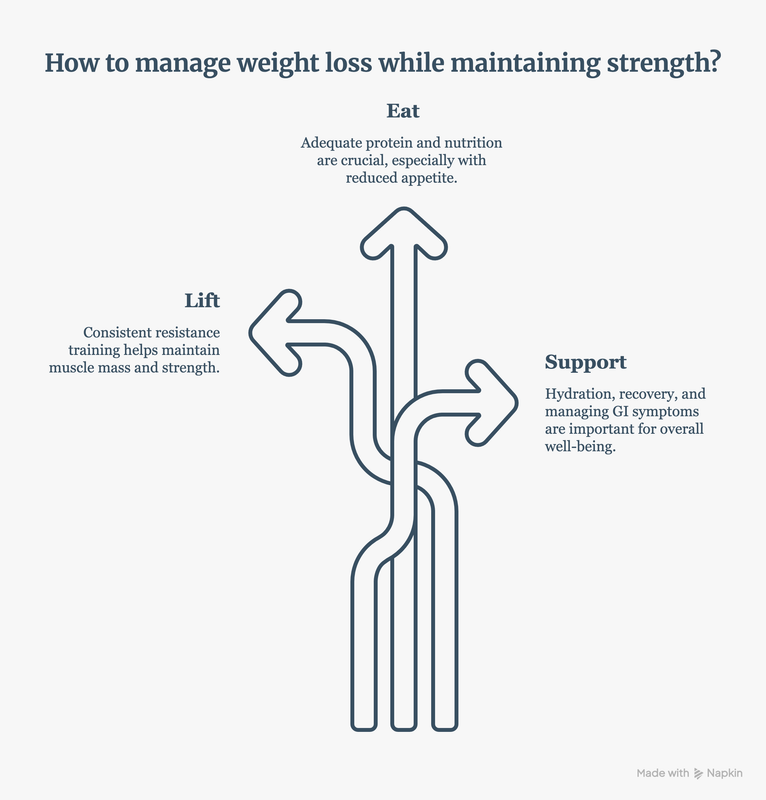
1. LIFT: Give Your Body a Reason to Keep Muscle
When you're losing weight, you're asking your body to operate with less available energy.
Resistance training provides a stimulus that tells your body:
This muscle is still needed.
That's different from simply doing more cardio or trying to burn as many calories as possible.
Cardiovascular exercise has many health benefits and absolutely has a place in a GLP-1 fitness programme.
But if your goal includes maintaining strength and muscle during weight loss, resistance training is particularly important.
You don't need to become a bodybuilder
The latest American College of Sports Medicine resistance-training position stand reinforces an important message:
Consistency matters more than complexity.
You don't need an elite gym, advanced techniques or a six-day training split.
For most adults, a practical resistance-training programme that regularly challenges the major muscle groups can provide an effective stimulus for maintaining and improving strength and physical function.
That might involve:
- Squats or sit-to-stand movements
- Lunges or step-ups
- Rows
- Presses
- Hip hinges
- Loaded carries
- Bodyweight exercises
- Resistance bands
- Dumbbells or machines
The equipment matters far less than consistency and progressive challenge.
How often should you strength train on a GLP-1?
A useful starting point for most people is at least two resistance-training sessions per week, targeting the major muscle groups.
If you're new to exercise, start with what you can recover from and build gradually.
The best programme isn't the one that looks impressive on paper.
It's the one you can keep doing.
2. EAT: Give Your Body the Building Blocks
Resistance training provides the stimulus.
Protein provides the amino acids your body needs to build and repair tissue.
This becomes particularly relevant during weight loss.
When calorie intake decreases, getting adequate protein can help support the maintenance of lean tissue.
But there's a practical problem for people taking GLP-1 medication:
What happens when you're barely hungry?
Appetite suppression can make it surprisingly difficult to consume enough food—and therefore enough protein.
This is why protein shouldn't be left entirely to appetite.
Make it intentional.
Practical strategies include:
- Prioritising a protein source at meals
- Choosing nutrient-dense protein foods
- Using smaller, protein-focused meals
- Spreading protein intake throughout the day
- Using convenient protein-rich snacks when appropriate
- Considering liquid or softer protein options when appetite or nausea makes solid food difficult
There is no single protein target that applies perfectly to everyone taking Ozempic, Wegovy or Mounjaro.
Your needs depend on factors including your body size, age, training, activity levels, diet and goals.
Adequate protein is important—but more isn't automatically better.
The priority is making sure you're getting enough to support your individual needs while maintaining an overall nutritionally adequate diet.
3. SUPPORT: Don't Forget the Rest of Your Nutrition
Protein isn't the whole equation.
Your body also needs adequate energy, carbohydrates, fats, vitamins, minerals and fluids.
This becomes particularly important when appetite is significantly reduced.
One of the mistakes we can make with GLP-1-assisted weight loss is assuming:
If less food means faster weight loss, then eating as little as possible must be better.
It isn't that simple.
The goal is an appropriate and sustainable calorie deficit, not the lowest possible food intake.
If you're consistently struggling to eat enough because of nausea, vomiting, early fullness or other gastrointestinal symptoms, that is something worth discussing with your prescribing or healthcare team.
Your medication should make weight management more manageable—not leave you unable to adequately fuel yourself.
What About Ozempic, Wegovy and Mounjaro?
You may have heard different claims about Ozempic muscle loss, Wegovy muscle loss or Mounjaro muscle loss online.
The important thing to understand is that these medications belong to a broader class of incretin-based treatments, and body-composition changes need to be interpreted in the context of overall weight loss.
Semaglutide is the active ingredient in Ozempic and Wegovy, while tirzepatide is the active ingredient in Mounjaro.
The medications can help reduce appetite and food intake, which can lead to substantial weight loss.
But the medication doesn't replace the need for physical activity, resistance training or adequate nutrition.
Think of it this way:
The medication can help create the opportunity for weight loss.
Your training and nutrition help determine how you support your body through that process.
How Do You Know If You're Maintaining Muscle?
The scales can't answer this question by themselves.
A lower body weight is useful information, but it doesn't tell you whether you've maintained your strength.
That's why it's worth tracking more than weight.
Look at:
Strength
Are you maintaining or improving your ability to lift, push, pull, squat and carry?
Physical function
Are everyday activities becoming easier?
Training performance
Can you continue to train consistently?
Energy and recovery
Do you have enough energy to exercise and recover appropriately?
Body composition
If appropriate and accessible, body-composition assessments can provide additional information—but they should be interpreted carefully.
Your goal isn't simply to become lighter.
Your goal is to become healthier, stronger and more capable while reducing excess body fat.
Lose the Weight. Keep Your Strength.
GLP-1 medications can be powerful tools for weight management.
And the evidence does show that weight loss can involve changes in both fat mass and lean mass.
But that isn't a reason to fear the medication.
It's a reason to support your body while using it.
The strategy is straightforward:
LIFT
Resistance train consistently to give your body a reason to maintain strength and muscle.
EAT
Make adequate protein and overall nutrition intentional, particularly when appetite is reduced.
SUPPORT
Pay attention to hydration, recovery, GI symptoms and the practical realities of eating less.
You can't completely control what happens to your body during weight loss.
But you can control many of the inputs.
Lose the weight. Keep your strength. Build the fitness to keep it off.
That's the foundation of GLP-1 Fitness Coaching at WRK.
Key Sources
- Currier BS, et al. American College of Sports Medicine Position Stand: Resistance Training Prescription for Muscle Function, Hypertrophy, and Physical Performance in Healthy Adults. Medicine & Science in Sports & Exercise, 2026.
- Eisa N, Barood O. Lean Mass Changes With Incretin Therapy Versus Lifestyle Intervention: A Systematic Review and Meta-Analysis of Randomised Controlled Trials. Diabetes, Obesity and Metabolism, 2026.
- Look M, et al. Body composition changes during weight reduction with tirzepatide in the SURMOUNT-1 study of adults with obesity or overweight. Diabetes, Obesity and Metabolism, 2025.
- Laverde LP, et al. Effect of GLP-1 receptor agonists at doses for obesity management on muscle health: systematic review and meta-analysis of randomized controlled trials. International Journal of Obesity, 2026.
- Mechanick JI, et al. Strategies for minimizing muscle loss during use of incretin-mimetic drugs for treatment of obesity. Obesity Reviews, 2024.
- Mozaffarian D, et al. Nutritional Priorities to Support GLP-1 Therapy for Obesity. Obesity, 2025.
Common Inquiries on this Topic
Does Ozempic cause muscle loss?
Ozempic does not appear to directly "destroy" muscle. Like other approaches that produce significant weight loss, treatment with semaglutide can be associated with reductions in lean mass alongside reductions in fat mass. However, lean mass is not the same as skeletal muscle, and measurements can also be affected by factors such as hydration and glycogen.
Resistance training and adequate nutrition can help support muscle and strength during weight loss.
How can I prevent muscle loss while taking Wegovy?
You cannot guarantee zero muscle loss during weight loss, but you can support muscle preservation by combining regular resistance training with adequate protein and overall nutrition.
For most people, consistency is more important than having a complicated exercise programme.
Does Mounjaro cause muscle loss?
Mounjaro (tirzepatide) produces substantial weight loss, and body-composition studies show that this includes reductions in both fat mass and lean mass. In the SURMOUNT-1 body-composition analysis, approximately 75% of weight lost was fat mass and 25% was lean mass.
Importantly, lean mass should not automatically be interpreted as skeletal muscle.
What is the best exercise to prevent muscle loss on a GLP-1?
Resistance training is the most important type of exercise to prioritise if maintaining strength and muscle is a goal during weight loss.
You don't need to lift extremely heavy weights or train every day. A consistent programme that challenges the major muscle groups and progressively develops strength can provide an important muscle-preservation stimulus.
How much protein should I eat on a GLP-1?
There isn't one protein target that applies to every person taking a GLP-1 medication. Requirements vary depending on factors such as body size, age, activity, resistance training and overall goals.
The key is to make protein intake intentional, particularly when appetite suppression makes it difficult to eat enough.
If you're struggling to meet your nutritional needs because of nausea, vomiting or significant appetite suppression, speak with your healthcare professional or a registered dietitian.
H. Richards
Personal TrainerWith over 20 years of experience coaching high performers, H. Richards delivers precision training frameworks built on evidence and practical application. His approach cuts through the noise to help you achieve sustainable results, backed by consistently excellent 5-star client reviews.
Explore Coaching ProgramsWondering if your GLP-1 weight-loss approach is supporting your muscle, nutrition and hydration? Take the free 2-minute GLP-1 Safety Assessment
Take our 2-minute assessment to evaluate your current protein intake and training consistency.
Take the Free Assessment